TL;DR: For a Dallas plumbing company, hiring a senior data analyst costs $90,000 to $140,000 a year, and fewer than 6% of companies under 100 employees have any analytics role at all. A self-serve AI tool costs $20 to $45 a month — but Copilot needs expensive Fabric capacity, and in a 2026 test every AI tool made at least one confident mistake on messy data. The split works: AI does the daily numbers, a human checks the big calls.
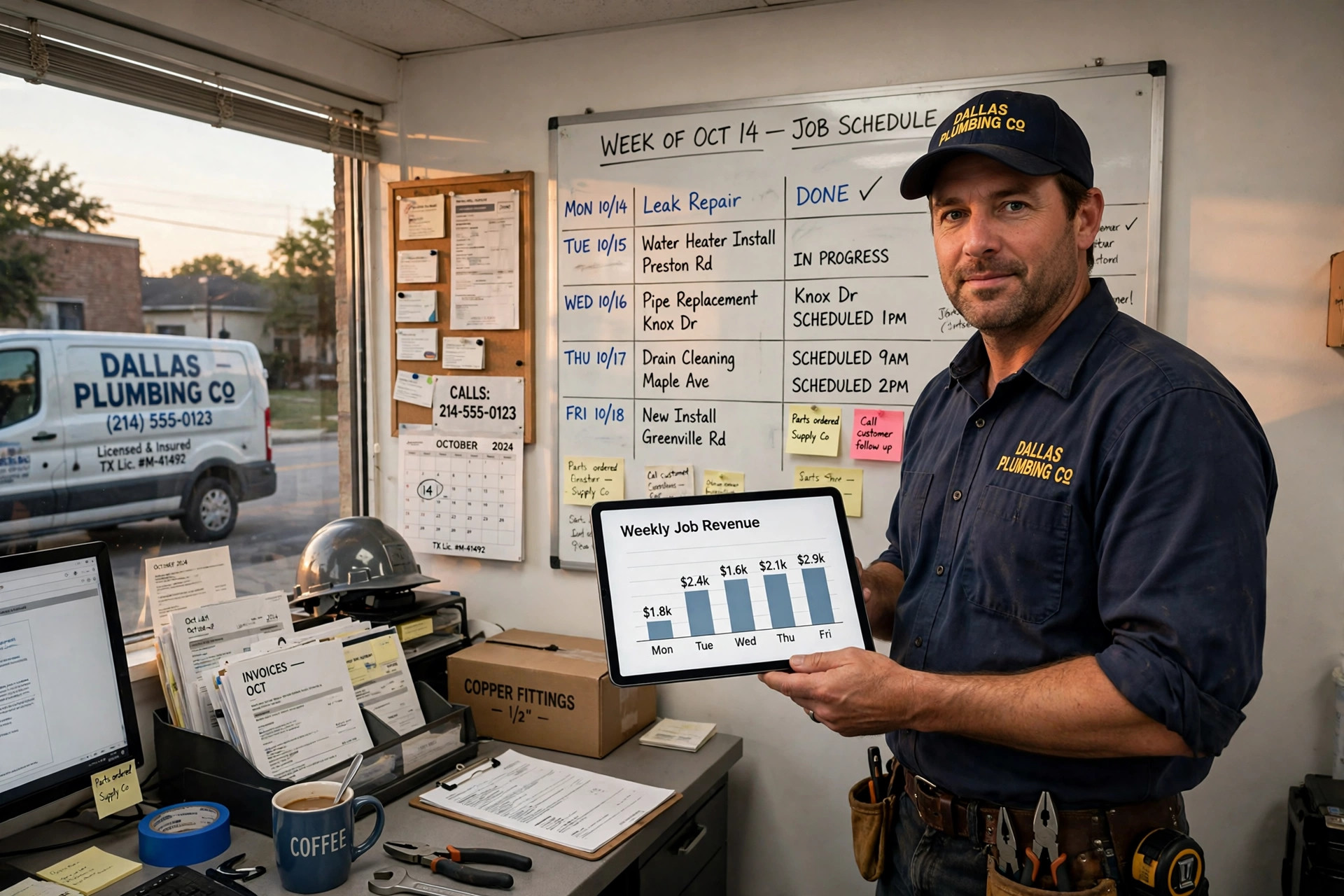
Meet Dale — and the Monday his numbers lied to him
Dale runs a plumbing and HVAC company in Dallas–Fort Worth. Fourteen trucks, twenty-two people, two dispatchers, one office manager named Rosa who has been there eleven years and knows every customer by voice.
On a Monday morning in November, Dale opened his job-management software and saw a number that made no sense. October revenue looked great. But the bank account said otherwise. Rosa spent the morning exporting spreadsheets, and by lunch they found it: three big commercial jobs had been marked "complete" in the dispatch board but never invoiced. The money was real work, done, unbilled — sitting in a column nobody was watching.
That is the question this piece answers: should a company like Dale's hire a data analyst, buy an AI data analyst, or do something else entirely — and what does each option actually cost in Dallas in November 2026?
The short answer: neither extreme wins
An AI data analyst is software that answers business questions in plain English. Connect it to your job software and accounting — or just upload a file — ask "which technician had the lowest callback rate last month?" and it writes the query, runs it, and hands you a chart. No SQL. No ticket queue.
A hired data analyst is a person who does the same job, plus the parts software cannot do: deciding which question matters, noticing that the data itself is wrong, and standing behind a number when a big decision rides on it.
Both are real options. Both have real prices. And for a 14-truck plumbing company, both extremes are wrong on their own. The hire is too expensive for the volume of questions a company this size actually asks. The tool is too trusting of data that, in a plumbing company, is never clean. What works is the split: the AI answers the daily questions, a human owns the weekly check and the big calls.
What the numbers actually look like in Dallas
Before prices, do the maths on the status quo. Rosa spends roughly six hours a week pulling numbers: Monday revenue, Friday payroll hours, the monthly "which jobs lost money" hunt. That is 300 hours a year of your most experienced office person doing copy-paste instead of running the office — and it still missed three unbilled jobs, because a tired human copying columns is exactly how unbilled jobs happen.
Now the hire. A senior data analyst costs $90,000 to $140,000 a year in total compensation in the US, according to a 2026 build-vs-buy analysis by Anomaly AI; a data engineer costs $120,000 to $180,000, and a minimal two-person analytics function costs $250,000 to $400,000 a year. The US Bureau of Labor Statistics puts the national median annual wage for data scientists at $120,230 as of May 2025.
And here is the number that decides it: according to LinkedIn workforce data cited by Clarivian, fewer than 6% of companies with under 100 employees have a dedicated data or analytics role. Dale's company is not behind. It is normal. A 14-truck plumbing company generates about five hours of questions a week — not enough to fill a $90,000-a-year person. The freelance middle ground is no bargain either: $2,000 to $5,000 a month for a freelancer, $4,000 to $7,000 for a junior in-house, $5,000 to $10,000 a month for an agency retainer, and consultancy projects at $150 to $300 an hour for mid-tier firms. For five hours of questions a week, every one of those is a sledgehammer for a nail.
The price ladder: what an AI data analyst costs in November 2026
Rung 1 — DIY chatbots, $0 to $20 a month. ChatGPT (free, or about $8 a month for Go) and Claude (free, about $20 a month for Pro) will take a CSV upload, clean it, spot duplicates, fix dates and build charts. Gemini does the same inside Google Sheets, where a plumbing company's data often already lives. This rung answers one question once. What you do not buy is a connection to live data, scheduled reports, or any memory of what "a completed job" means in your company.
Rung 2 — AI analyst products, $16 to $45 a month. Better Analyst is free to start, with Pro at $20 a month billed annually ($30 month-to-month) and Team at $149 a month. Anomaly AI runs Free, Starter at $16 a month, Pro at $25, and Team at $45 per seat a month. These connect to Excel, Google Sheets, GA4, BigQuery, Snowflake or MySQL, answer in plain English, and send the answer on a schedule. One Pro plan for a year ($300) costs less than a single month of a managed analytics retainer. This is the rung that makes the hire unnecessary for most small companies.
Rung 3 — BI platforms with AI, $14 to $50 per user a month. Microsoft Power BI Pro is $14 to $24 per user a month, with Copilot-assisted reports — but Copilot needs supported Fabric capacity, administrator configuration and eligible regional settings, which is where the real bill hides. Tableau Pulse is $15 to $35 per user a month, with Tableau Agent and proactive KPI digests. ThoughtSpot's Spotter is $25 to $50 per user a month. Zoho Analytics offers conversational analysis through Ask Zia, and Google Looker Studio pairs Gemini-assisted analysis with free website reporting. These are serious tools built for companies that already have someone who owns the data. A plumbing company with no data owner buys a dashboard nobody maintains, and dashboards nobody maintains are how three unbilled jobs hide for a month.
Rung 4 — an installed AI Data Analyst, $2,500 to $12,500 setup. VisionQuantech's AI Data Analyst is installed for the company rather than rented as a login: Starter $2,500–$4,500 setup with $500–$800 a month care, Growth $4,500–$6,500 with $999 a month care, All-in-One $8,500–$12,500 with $1,999 a month care. Founding clients get 20% off the first project setup — first ten clients only. The difference is that the system is connected to the company's actual job software and accounting, configured to its definitions, and the weekly verification check is part of the installation. It is a service, not a login.
For Dale, the comparison that matters is simple. A hire costs $90,000+ a year and sits idle half the time. Rung 2 costs $300 a year and answers the daily questions — but trusts whatever Rosa uploads. Rung 4 costs more than rung 2 and less than a tenth of a hire, and it is the only rung where somebody else's job is making sure the number is right.
The comparison table
| Option | What you pay | What you get | The catch for a Dallas plumbing company |
|---|---|---|---|
| Hire a senior analyst | $90K–$140K/yr total comp | Judgement, context, accountability | 5 hrs of questions a week cannot fill a $90K person; <6% of small companies have one |
| Freelance analyst | $2,000–$5,000/mo | Flexible, no headcount | Inconsistent quality; every question is a new ticket |
| Agency / consultancy | $5,000–$15,000/mo retainer | Strategic depth, project delivery | 6–12 month minimums; $150–$500/hr; built for bigger companies |
| ChatGPT / Claude / Gemini | $0–$20/mo | Fast one-off answers from an uploaded file | No live connection, no schedule, no memory of your definitions |
| Better Analyst | Free; Pro $20/mo | Plain-English questions, dashboards, scheduled answers | You still own data quality and definitions |
| Anomaly AI | Free; $16–$45/mo | Connects Excel/Sheets/BigQuery, asks and answers, scheduled | Same: garbage in, confident garbage out |
| Power BI + Copilot | $14–$24/user/mo | Copilot reports, Excel-native | Copilot needs Fabric capacity + admin setup — the real bill hides there |
| Tableau Pulse | $15–$35/user/mo | Proactive KPI digests, Tableau Agent | Enterprise BI pricing for a 14-truck company |
| VQ AI Data Analyst | $2,500–$12,500 setup + $500–$1,999/mo care | Installed on your job + accounting data, weekly verification included | Service, not self-serve; founding 20% off first 10 only |
What the reviews and the tests actually say
YouTube mining. The pattern across this week's top AI creators is verdict-first plus one running real example plus numbers on screen. Alex Hormozi's November 2026 AI statements carry the sharpest warning: he capped AI budgets after revenue stagnated despite high spending, citing a $350,000 wasted automation project, and now advises automating only bottleneck tasks and keeping strategic decisions human. His numbers for agents that do work are concrete: 90% support ticket resolution via agents, one AI SDR selling 200 units a month. Matt Wolfe's AI News roundup for the week of 13 November 2026 — Claude Fable 5.2 and Mythos 5.2 launched 9 November, Google's Gemini 4 Carbon going public — shows the same pattern: the tools change weekly, the buying question does not. The lesson for Dale is Hormozi's: automate the bottleneck (Rosa's six hours of copy-paste), keep the strategic call (which jobs to chase, which technician to coach) human.
Reviews mining — the field-service software Dale already pays for. The analytics gap is not theoretical; it is the most common complaint in the reviews of the tools plumbing companies already run. FieldEdge's biggest gap is reporting: its analytics dashboard offers little visibility into productivity metrics like average job time or overtime, according to Connecteam's review. FieldEdge charges $100 a month per office user and $125 a month per technician, plus a $500 to $2,000 setup fee — and still leaves the owner blind on the numbers that matter. Service Fusion's most consistent complaint is offline reliability: nearly 74% of reviewers who mentioned offline mode flagged it as a problem, according to SelectHub's review analysis. ServiceTitan, the industry leader, scores 4.5 out of 5 across 24 verified reviews on Software Finder, but its pricing is quote-only with implementation fees, and the most common complaint is simple: prices keep rising. Housecall Pro starts at $79 a month and Jobber at $49 a month, but reviewers consistently note weaker reporting. The pattern is unmistakable: the dispatch tools run the trucks, but none of them answers the owner's questions.
The accuracy test. In November 2026, MustUseAI fed the same messy year of small-business sales data — duplicates, bad dates, the usual problems — to four AI tools and asked each to clean it, find what changed and chart it. The headline result: every tool made at least one confident mistake — a dropped row, a wrong total, a misread date. ChatGPT was the most complete all-rounder but also the most confident when it was wrong. Claude was the pick for messy data and careful explanations. Gemini won wherever the data already lived in Google Sheets. Perplexity was the only one built for questions whose answer lives on the live web. The test's own warning is the one to print out: verify the numbers before they go into a report. That is not a reason to avoid AI analysis. It is the reason the weekly human check exists.
The three questions every Dallas plumber actually asks
Mine the comments under those YouTube videos and the reviews above, and the same four questions keep appearing — in different words, from different owners, in different cities. Here they are, answered for Dale's company.
1. Which jobs actually made money last month? Not revenue — profit, after technician time, parts, drive time and callbacks. This is the question that catches the unbilled commercial jobs and the loss-making "quick" calls — and it also answers whether the board is full or just disorganised, because average job time and overtime are the same numbers. An AI analyst answers it in seconds from the job and accounting data, if the data records technician time honestly. The trap: if techs log round hours, the answer is fiction.
2. Which technician has the highest callback rate, and why? Callbacks are the quiet profit leak in plumbing. One technician at 14% callbacks and another at 4% is a coaching conversation worth thousands a month. The AI finds the pattern; the human has the conversation. No tool should rank people without a human reading the context — a tech who takes the hardest jobs will always look worse on raw numbers.
3. What should we charge? The average ticket, the close rate on quotes, the jobs lost to price — these are pricing questions, and they are the ones where a wrong AI answer costs real money fastest. A $50 error on a quote, repeated 40 times a month, is $2,000. This question always gets a human check, every time, no exceptions.
The four traps every plumbing company must survive
Trap 1 — dirty data, confidently analysed. The MustUseAI test is the whole trap in one sentence: every tool made at least one confident mistake. In a plumbing company the data is dirtier than a test spreadsheet: jobs logged under the wrong customer, "miscellaneous" as a parts category, invoices dated when typed rather than when the work was done. An AI analyst does not know any of that. It will give you a beautiful chart of a lie. The test before signing anything: give the vendor your messiest month and ask what it flags as wrong.
Trap 2 — the dashboard nobody opens. This is the fate of rung 3 in most small companies. Power BI is a serious tool, and Copilot is genuinely good at summarising a report — but a report nobody opens is a cost, not an asset. A 2023 Deloitte survey found 67% of business leaders do not feel comfortable accessing data or analytics on their own. And 60 to 70% of small and mid-size businesses name budget constraints as the main obstacle to adopting analytics — which means the tool has to earn its keep in the first month, not the first year. The fix is not a better dashboard. It is a scheduled answer: one email, Monday 7 a.m., five numbers, no login required.
Trap 3 — the Fabric gate. Power BI's $14 a month is real. What is also real is that Copilot needs supported Fabric capacity, administrator configuration and eligible regional settings. For a company with no IT person, that sentence is a project, a consultant, and a bill that arrives after the $14. Always ask for the total first-year cost, in writing, including setup — and compare that number, not the headline per-user price.
Trap 4 — ranking people by numbers you have not read. Callback rates, average job time, revenue per tech — these are management numbers, and the ones most likely to be unfair. The technician who takes the slab leaks and the 2 a.m. emergency calls will look slower and more expensive than the one who takes the easy water-heater swaps. An AI will rank them anyway, confidently, in a sorted table. The rule: no personnel decision ever comes from an AI table alone. The table starts the conversation; the dispatcher and the owner finish it.
The 5-step switch: how Dale's company actually does this
Step 1 — Pick one question, not a platform. Write down the single most expensive unanswered question. For Dale it was "which jobs made money last month?" For most plumbing companies it is the same question, or the callback question. One question. Everything else waits.
Step 2 — Audit the data for that question only. Export one month of jobs and invoices. Check: are completed jobs invoiced? Are technician hours real or rounded? Are callbacks tagged as callbacks? Fix what is broken for this question only. One question, one month, one fix.
Step 3 — Run the cheapest rung for two weeks. Upload the month to ChatGPT or Claude, or connect Better Analyst's free plan, and ask the question every Monday. If the answer is useful twice, the rung works. If it is wrong twice, the data is the problem, not the tool — go back to step 2.
Step 4 — Put a human check on the calendar. Monday 7 a.m.: the AI's five numbers arrive. Monday 7:15: Rosa or Dale spends fifteen minutes checking them against the bank, the dispatch board and one random job file. This is the step the MustUseAI test demands and the step most companies skip. Fifteen minutes a week is the entire quality system. Without it, you are flying on confident guesses.
Step 5 — Scale only what survived the check. If two months of Monday checks come back clean, connect the live data and add the second question — callbacks. If a check fails, stop, fix the data, and do not add questions until it passes again.
Frequently asked questions
Should a small plumbing company hire a data analyst or use AI?
For most companies under 100 employees, AI. A senior analyst costs $90,000 to $140,000 a year in total pay, and fewer than 6% of companies that size have a dedicated analytics role — because five hours of questions a week cannot fill a full-time person. An AI analyst product at $16 to $45 a month answers the daily questions; the hire is only justified when you need custom models, proper experiment design, or someone to sign off on numbers for investors or lenders.
How much does an AI data analyst cost for a small business?
From free to about $45 a month for self-serve products: Better Analyst is free with Pro at $20 a month, Anomaly AI runs $16 to $45 a month. BI platforms with AI run $14 to $50 per user a month, but the real cost includes setup — Power BI Copilot needs Fabric capacity, for example. An installed AI Data Analyst service runs $2,500 to $12,500 one-time setup plus $500 to $1,999 a month care.
Can AI replace a data analyst?
It can replace the routine half: pulling reports, joining data, writing summaries, building charts. It cannot decide which question matters, fix dirty data on its own, or take responsibility for a wrong number. In a November 2026 test, every AI tool made at least one confident mistake on messy data. The working model is AI for the daily numbers plus a human check on the big calls.
What is the best AI data analyst tool for a plumbing company in Dallas?
There is no single best tool — it depends on where your data lives. If it is in spreadsheets, start with ChatGPT, Claude or Gemini. If you want scheduled plain-English answers from connected data, Better Analyst or Anomaly AI at $20 to $45 a month. If you already run Microsoft 365, Power BI — but price the Fabric capacity first. If you want the system installed on your job and accounting data with a weekly verification check included, that is the installed-service rung.
Why can't my field-service software answer these questions?
Because dispatch tools are built to run trucks, not to answer the owner's questions. FieldEdge's reporting offers little visibility into productivity metrics like average job time or overtime, ServiceTitan's analytics sit behind quote-only pricing, and Housecall Pro and Jobber are consistently rated weaker on reporting. The analytics gap in the tools you already pay for is exactly the job an AI data analyst fills.
How do I know if an AI analyst's numbers are right?
You check them, every week, for fifteen minutes: the AI's five numbers against the bank balance, the dispatch board and one random job file. If the check passes two months running, you scale. If it fails, you fix the data before adding more questions. No AI answer about money ever goes unchecked — that is the whole quality system.
References & further reading
- Anomaly AI — Data Analytics Services: Build vs Buy vs Use an AI Data Analyst (senior analyst $90K–$140K, consulting $150–$500/hr, retainers $5K–$15K/mo, Anomaly pricing). https://www.findanomaly.ai/data-analytics-services-outsource-vs-build-in-house
- Clarivian — Business Intelligence Without Analysts (fewer than 6% of companies under 100 employees have a dedicated data/analytics role; first-year AI BI cost $110K–$205K vs $2,988–$11,988). https://clarivian.io/blog/business-intelligence-without-analysts-2026
- MustUseAI — Best AI Data Analysis Tools 2026: Tested (every tool made at least one confident mistake on messy data; ChatGPT/Claude/Gemini/Perplexity compared). https://www.mustuseai.com/blog/best-ai-data-analysis-tools/
- Hacker9 — 8 Best AI Data Analytics Tools for Small Business Teams in 2026 (Power BI, Looker Studio, Zoho Ask Zia, Tableau Agent, Copilot's Fabric capacity requirement). https://hacker9.com/8-best-ai-data-analytics-tools-for-small-business-teams/
- Better Analyst — Best Analytics Software: 7 Tools Compared (2026) (Better Analyst Pro $20/mo, Metabase, Hex, pricing as of October 2026). https://betteranalyst.com/blog/best-analytics-software
- Pinnacle AI — Service Fusion vs FieldEdge: Full Pricing Comparison (Service Fusion $208–$533/mo, FieldEdge $100/$125 per user, 74% offline-mode complaints, reporting gaps). https://getpinnacle.ai/blog/service-fusion-vs-fieldedge
- Jotform — 8 best AI assistants for data analysis in 2026 (Power BI $14–$24, Tableau Pulse $15–$35, ThoughtSpot $25–$50 per user per month). https://www.jotform.com/ai/best-ai-assistant-for-data-analysis/
- Synthesis — Can AI Replace a Data Analyst for a Small Brand? (the routine-vs-judgement split; when to still hire). https://app.synthesisintelligence.ai/blog/can-ai-replace-a-data-analyst-for-a-small-brand
Cite this article: Shivam Kumar (2026). AI Data Analyst vs Hiring a Data Analyst: A Dallas Plumbing Company's Honest Comparison. VisionQuantech. https://visionquantech.com/blog/ai-data-analyst-vs-hiring-data-analyst-dallas-plumbing.html