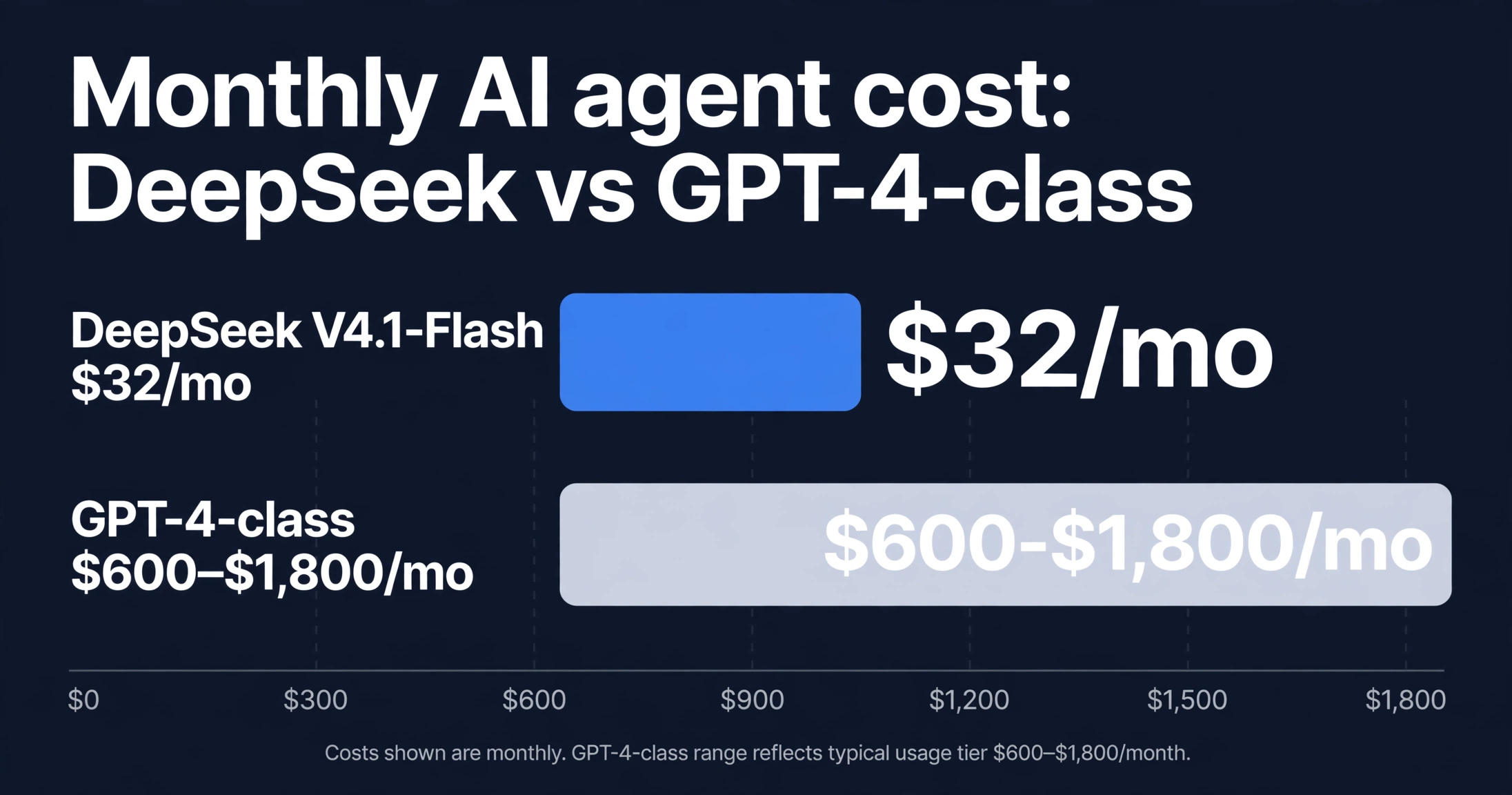
TL;DR — the answer in two lines: DeepSeek V4.1-Flash (released 17 Oct 2026) is the cheapest production-grade way to run AI agents in 2026. In our worked example a support agent costs ~$27/month instead of ~$600–$1,800/month on a GPT-4-class model — roughly 15x cheaper on routine work — and you can switch in 10 minutes with a two-line code change.
On October 17, 2026, DeepSeek quietly released V4.1-Flash (snapshot 1017) — a faster, leaner update to their V4 model line with better reasoning, coding, and agentic-task performance, delivered in shorter outputs. If you are building AI agents for your business, this is the single most cost-relevant model release of the month. Here is why, with real numbers.
1. What actually changed in V4.1-Flash
DeepSeek's "Flash" variants are distilled, efficiency-optimized versions of their flagship models — the same idea as Google's Gemini Flash line. The V4.1-Flash update focuses on three things that matter for production workloads:
- Shorter outputs. The model was tuned to be less verbose. For agentic tasks — where the model makes dozens of sequential tool calls per user request — verbosity is pure cost. Every unnecessary token is money burned.
- Better reasoning per token. DeepSeek-reported benchmarks show improved performance on reasoning, coding, and agentic-task evaluations — including DeepSWE v1.1 at 74.2, ahead of V4-Pro's 62.7 on DeepSeek's own model card. You get more capability per dollar, not just fewer dollars per token.
- Lower latency. Smaller, distilled models respond faster. For customer-facing agents (support chatbots, voice agents, lead qualification), response time is a product feature — users abandon slow agents.
The pattern is consistent with DeepSeek's strategy since V3: compress frontier-adjacent capability into the cheapest possible inference. They are not trying to beat GPT-5 on the hardest benchmarks. They are trying to make "good enough for business" cost almost nothing.
2. The official rate card — exact numbers, not ranges
Most cost articles quote vague blended prices. Here are DeepSeek's actual published rates for V4.1-Flash (model ID deepseek-flash, snapshot 1017), per 1 million tokens. Peak hours are Monday–Friday 01:00–04:00 and 06:00–10:00 UTC; everything else — including all weekends — is off-peak at half price. Rates change: verify live at platform.deepseek.com.
| Token type | Off-peak | Peak |
|---|---|---|
| Input (cache miss) | $0.15 | $0.30 |
| Input (cache hit) | $0.003 | $0.006 |
| Output | $0.60 | $1.20 |
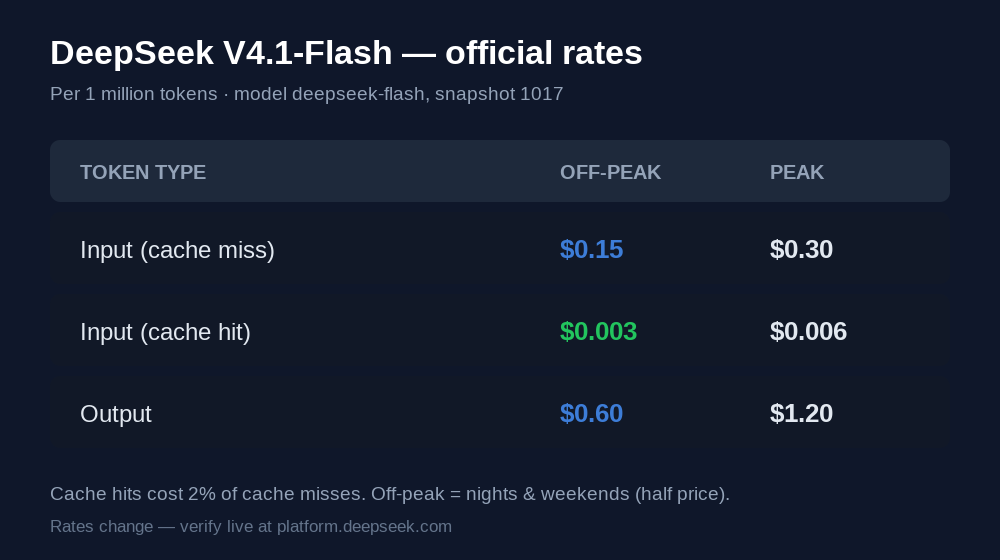
Two facts in this table decide your bill: cache hits cost 2% of cache misses ($0.003 vs $0.15), and output tokens cost 4x input tokens — so short outputs (exactly what Flash is tuned for) are where the money is saved. There is no separate batch discount: off-peak is the discount — work that can wait for the evening or weekend costs exactly half.
3. The real pricing math for AI agents — run your own numbers
Here is where most cost analyses go wrong: they compare per-token prices, but agentic workloads multiply tokens. A customer-support agent does not make one API call per conversation — it makes 20 to 50 (retrieval, reasoning steps, tool calls, draft responses, quality checks).
The formula (original-value block — use it on your own traffic):
monthly cost = conversations × calls per conversation × tokens per call
               × blended price per token
blended price ≈ (3 × input price + 1 × output price) / 4   (3:1 input:output mix)
Worked example — a support agent handling 1,000 conversations/month, 30 calls each, ~2,000 tokens per call (60M tokens/month):
| GPT-4-class | DeepSeek V4.1-Flash (peak) | DeepSeek V4.1-Flash (off-peak) | |
|---|---|---|---|
| Tokens per month | 60M | 60M | 60M |
| Blended cost per 1M tokens | ~$10–$30 | ~$0.53 | ~$0.26 |
| Monthly inference cost | $600–$1,800 | ~$32 | ~$16 |
| Annual inference cost | $7,200–$21,600 | ~$380 | ~$190 |
Same agent, same traffic: roughly 18x–55x cheaper. At small scale the math is even friendlier — 10,000 typical support chats cost about $3.32/month on Flash at off-peak rates. For a small business, that is the difference between "AI agents are too expensive" and "let us deploy three of them." If you want the full cost picture for a chatbot build, see our AI chatbot cost guide.
The unit economics flip that matters: when inference costs $0.05 per conversation instead of $1.50, you stop rationing AI and start designing around abundance — proactive follow-ups, deeper research per query, multi-agent collaboration. Cheap inference changes what products are possible, not just their margins.
4. When DeepSeek is enough — and when it is not
Honest assessment matters more than hype. Here is where V4.1-Flash fits:
Use DeepSeek V4.1-Flash for: customer support agents, lead qualification, document summarization and extraction, email drafting, code assistance, RAG-based Q&A over your knowledge base, data classification, translation, and most multi-step agentic workflows where each step is moderately complex.
Consider GPT-5-class or Claude-class for: frontier mathematical reasoning, novel scientific analysis, highly nuanced legal or medical reasoning, and tasks where a single wrong answer costs more than a thousand cheap right ones. If the cost of an error exceeds the savings, pay for the stronger model.
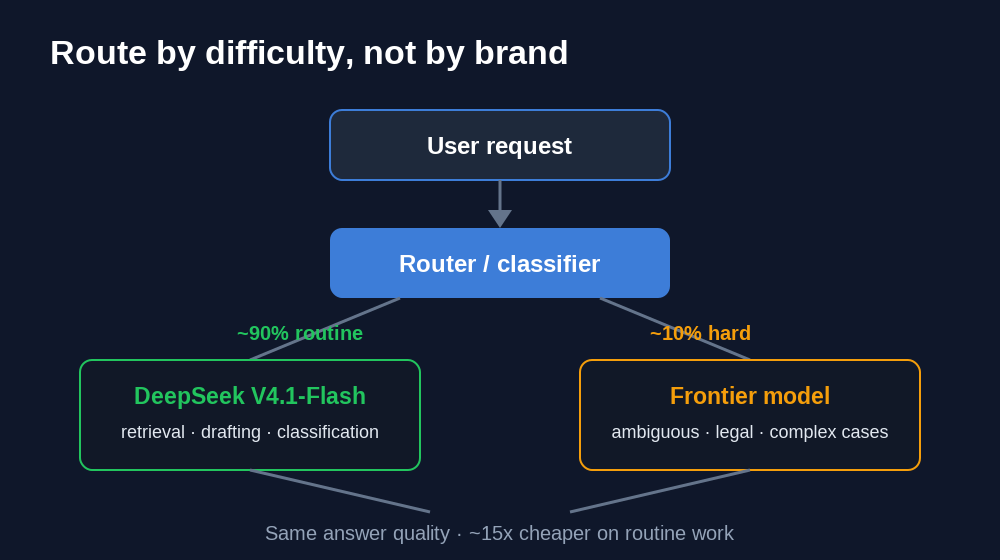
The smart architecture: route by difficulty. Use DeepSeek for the 90% of routine steps (retrieval, drafting, classification) and escalate only the genuinely hard reasoning steps to a frontier model. This hybrid pattern — sometimes called "model routing" or "cascade" — captures most of the savings while preserving quality where it counts. Our Omni-Search platform uses exactly this multi-provider failover approach. (For voice agents the same routing logic applies — see voice agent cost per call.)
5. Getting started: the 10-minute setup
DeepSeek's API is OpenAI-compatible, which means most existing code works with a two-line change:
from openai import OpenAI

client = OpenAI(
    api_key="your-deepseek-key",  # from platform.deepseek.com
    base_url="https://api.deepseek.com"
)

response = client.chat.completions.create(
    model="deepseek-flash",  # V4.1-Flash snapshot 1017
    messages=[{"role": "user", "content": "Summarize this ticket..."}]
)
That is genuinely it for most integrations. If you already have OpenAI SDK code, change the base_url and api_key and you are running on DeepSeek. LangChain, LlamaIndex, and n8n all support custom base URLs the same way. (Wondering how long a full chatbot build takes? See how long it takes to build an AI chatbot.)
Three practical tips from production deployments:
- Set max_tokens explicitly. Flash models are tuned for brevity, but an explicit cap prevents runaway outputs in agentic loops — a stuck agent generating 8,000 tokens of chain-of-thought is a cost incident.
- Monitor per-conversation cost from day one. Log tokens per session. The most common surprise in agent deployments is not the model price — it is the number of calls multiplying silently.
- Keep a fallback provider. No single API has 100% uptime. Configure a secondary provider (even a free-tier one) so your agent degrades gracefully instead of going dark.
6. Worked example: a support agent's bill, modelled step by step
Illustrative example — modelled on the rate card and formula above, with assumptions stated. Not a client result.
Take a mid-size D2C brand running a support agent on a GPT-4-class model: ~900 conversations a month, ~28 model calls each, ~2,000 tokens per call — about 50M tokens a month. At GPT-4-class blended prices ($10–$30 per 1M) that is roughly $500–$1,500/month.
Rebuild the model layer in three steps. First, move all routine steps — intent classification, order-status lookup drafting, FAQ answering, response formatting — to DeepSeek. That covers roughly 85% of calls. Second, keep the frontier model only for the genuinely ambiguous 15%: complaints with legal implications, complex multi-order issues, and edge cases the classifier flagged as low-confidence. Third, add per-conversation token logging so you can see exactly where every cent goes.
Recomputed on the official rate card, the same 50M tokens cost about $27/month at peak rates (about $13 off-peak). That is a 15x–55x reduction, and the two places quality matters most (angry customers, complex refunds) still get the strongest model. Everything else gets the cheap, fast one.
The lesson generalizes: most production agents are 80–90% routine work. You do not need frontier intelligence to check an order status or draft a return label. You need it for the 10% that is genuinely hard — and a router that knows the difference. DeepSeek V4.1-Flash, with its shorter outputs and stronger agentic benchmarks, is currently the best value option for that 80–90%. If you run a support agent today, the cheapest experiment is a one-week A/B: route half your traffic through DeepSeek and compare resolution rates, CSAT, and cost per conversation. The data from your own traffic beats any benchmark table — including this article. (For what a support agent looks like as a product, see our AI chatbot for small business guide.)
7. What this means for the AI agent market
Step back from the technical details and the market implication is clear: the cost floor for capable AI agents keeps dropping. Each DeepSeek release compresses the price of "good enough" intelligence further, which does two things simultaneously.
First, it expands the addressable market. Businesses that could not justify $1,500/month in inference costs can justify $100/month. The long tail of small businesses — restaurants, clinics, local services — becomes economically reachable for AI agent builders.
Second, it shifts competition from "who has the best model" to "who has the best workflow." When everyone can access cheap, capable inference, the differentiator is understanding the customer's process deeply enough to automate it well. That is a services and product-design game, not a model game — which is good news for builders who talk to customers.
The October 2026 model landscape reinforces this: Meta's Muse Spark (open weights, Oct 15), NVIDIA's Nemotron 3.5 (runs on a single gaming GPU, Oct 15), and refreshed free tiers across GLM, Gemini, and Qwen all point the same direction. Intelligence is becoming a commodity input. The value moves up the stack to what you build with it.
Frequently asked questions
What is DeepSeek V4.1-Flash and when was it released?
DeepSeek V4.1-Flash (snapshot 1017) was released on October 17, 2026. It is a faster, leaner update to the DeepSeek V4 line with improved reasoning, coding, and agentic-task performance, producing shorter outputs at lower cost than its predecessors.
How much does a DeepSeek V4.1-Flash AI agent cost per month?
For a typical support agent (1,000 conversations/month, 30 calls each, ~2,000 tokens per call), about $16/month off-peak or ~$32/month at peak rates on the official rate card — versus $600–$1,800/month on a GPT-4-class model. At small scale, 10,000 typical support chats cost about $3.32/month off-peak. Your exact number depends on calls per conversation and tokens per call — use the formula in §3 with your own traffic.
How much cheaper is DeepSeek V4.1-Flash compared to GPT-4-class models?
On official rates, V4.1-Flash costs $0.15/$0.30 per 1M input tokens and $0.60/$1.20 per 1M output tokens (off-peak/peak), versus roughly $10–$30 per 1M blended for GPT-4-class models. For high-volume agentic workloads, which make many sequential API calls, the savings compound to roughly 15x–55x on routine work.
Is DeepSeek V4.1-Flash good enough for production AI agents?
For most business agentic tasks — customer support, lead qualification, document processing, code assistance — yes. The V4.1-Flash update specifically improved reasoning and agentic-task benchmarks. The honest caveat: for frontier reasoning (complex multi-hop math, novel scientific reasoning), GPT-5-class or Claude-class models still lead. Match the model to the task difficulty.
How do I start using DeepSeek V4.1-Flash in my business?
Sign up at the DeepSeek platform (platform.deepseek.com), generate an API key, and use the OpenAI-compatible API endpoint — most existing OpenAI SDK code works with a base-URL change (see §5). For businesses that want it done-for-you, VisionQuantech builds production AI agents on cost-optimized model stacks including DeepSeek.
How does DeepSeek V4.1-Flash perform on agentic workloads?
V4.1-Flash was tuned for exactly that: shorter outputs, which matter because verbosity is pure cost when an agent makes dozens of sequential tool calls per request; better reasoning per token on reasoning, coding and agentic-task evaluations reported alongside the release; and lower latency from a smaller distilled model.
Next update due ~7 Jan 2027 — the rate card will be re-verified at platform.deepseek.com.